


My flight to Amritsar landed at 12:30 pm.
With admirable optimism and accurate mathematics, I assumed I would reach the hotel by 1. And I did—as efficiently as a person with one backpack and no checked-in baggage can.
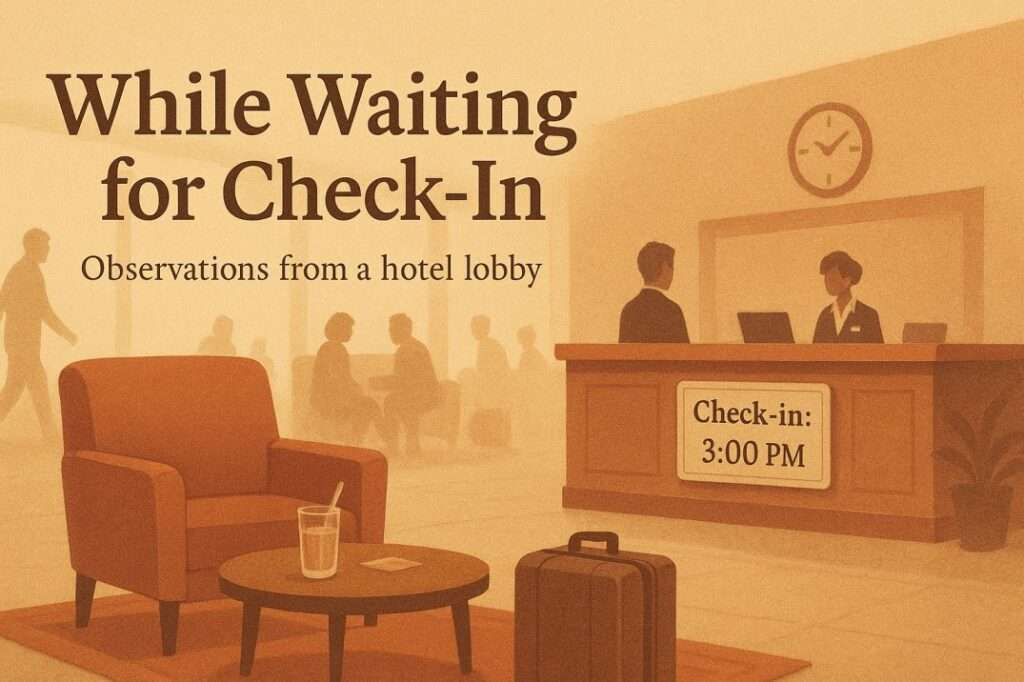
What I hadn’t accounted for was the small but mighty detail printed clearly on my booking:
Check-in: 3:00 pm.
The staff at the reception confirmed it with the politeness of people who have delivered this message many times.
“You’re a bit early, sir. The room is still being prepared.”
To kill time, I went to a well-known dhaba for lunch. It was crowded, with funny boards like ‘A Punjabi’s blood group is Ghee positive’. Nevertheless I helped myself to an Amritsari Kulcha Chole Thali and a glass of sumptuous lassi.
This usually solves all human problems, but even a leisurely Punjabi meal can only stretch so much.
By 2:30, I was back at the hotel lobby—well-fed, well-travelled, and still without a room.
The staff smiled again. The room was “almost ready.”
Almost, of course, being one of the most elastic words in hospitality.
With nothing to do, I settled into the lobby and began doing what travellers eventually do when they have nothing to do:
observe people.
There was an impatient guest pacing near the reception, constantly peering at his watch, as if it had personally wronged him by being 30 minutes late. He reminded me of Swami – impatient energy and all.
And then, there was another tourist couple, rummaging through maps and routes, but peacefully slumped on a couch. Check-in time being 30 minutes away didn’t bother them. Perhaps, they had a touch of Jigneshbhai’s genes.
A family, meanwhile, was opening and closing their suitcases every few minutes. Clearly they had arrived directly from the airport and convinced themselves that they would evoke enough sympathy to get a room before check-in time.
As I watched them, a thought drifted in —
what if Jigneshbhai and Swami were here, waiting for check-in with me?
Swami, I imagined, would find the very concept of a 3 pm check-in unreasonable. He would hover near the reception, hoping the staff might discover an unoccupied room through sheer persistence. Jigneshbhai, meanwhile, would treat the situation as a gentle reminder from the universe to slow down. He would sit comfortably on the lobby sofa, possibly sipping a complimentary welcome drink, observing the scene with quiet amusement.
In my mind’s eye, Swami would try to negotiate with time itself, and Jigneshbhai would simply accept whatever time chose to offer. And somehow, both would leave the lobby believing their approach had worked. Or maybe, Jigneshbhai would later convince Swami that he might as well have had the welcome drink instead of pacing up and down.
I returned from that little mental diversion to the actual lobby around me just as the receptionist informed another hopeful guest that their room was “almost ready.”
I smiled. Some things are universal.
Eventually, my room was ready too—right on time, which in hotel language means right when it is meant to be.
As I rode up in the lift, it occurred to me that waiting rooms often reveal people far more honestly than meeting rooms ever do.
Some wait with irritation, some with resignation, some with rehearsed politeness, and some with a kind of quiet surrender.
The room, after all, is just where the stay begins.
But the waiting area at the reception — that’s where the stories truly are.
***