


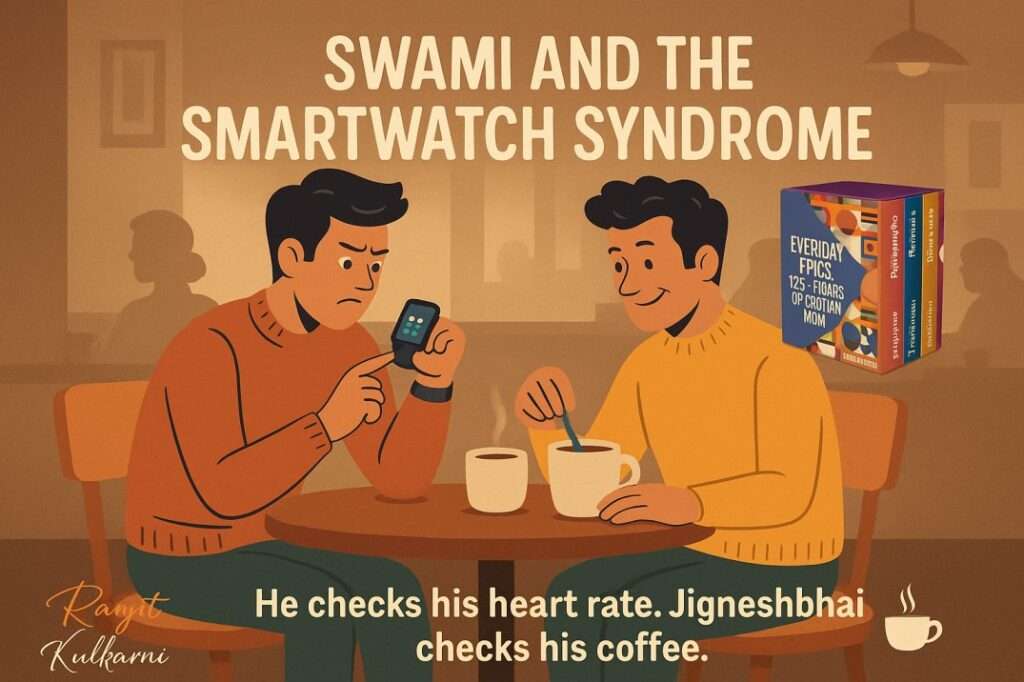
When Swami walked into the café last Sunday, he wasn’t looking at us.
He was staring at his wrist.
“Sixty-eight,” he muttered. “No, now seventy-two. How can it change so fast?”
Jigneshbhai didn’t even look up from his coffee. “What’s changing?”
“My heart rate!” Swami exclaimed, tapping his brand-new smartwatch. “It keeps going up and down. I was calm a minute ago.”
Jigneshbhai stirred his cup. “And now?”
“Now I’m worried,” Swami said, eyes widening. “Maybe the watch is faulty. Or maybe I’m not breathing properly.”
He took a deep breath — the kind that makes other people in cafés turn and look. The smartwatch beeped again.
“See? It just went up five points. I’m telling you, Jigneshbhai, something’s wrong.”
Jigneshbhai smiled. “Looks like your problem isn’t the watch, Swami. It’s the watcher.”
But Swami wasn’t listening. He had already switched to the sleep tracker, frowning. “It says I slept six hours thirty-two minutes last night. But I woke up tired. How can that be accurate?”
“Maybe you dreamt of meetings,” Jigneshbhai said, sipping his coffee.
Swami looked unconvinced. He started scrolling again. “Wait. Now it says I’m stressed.”
I tried not to laugh. “It probably senses that.”
By the time the bill came, Swami had checked his oxygen levels, stress index, and steps count twice. The smartwatch was exhausted. So was Swami.
As we got up to leave, Jigneshbhai put a hand on his shoulder.
“Swami,” he said, “the watch is supposed to track your life. Not live it for you.”
Swami looked down at his wrist and sighed. “You think I should return it?”
Jigneshbhai smiled. “No, just stop consulting it before coffee.”
***