


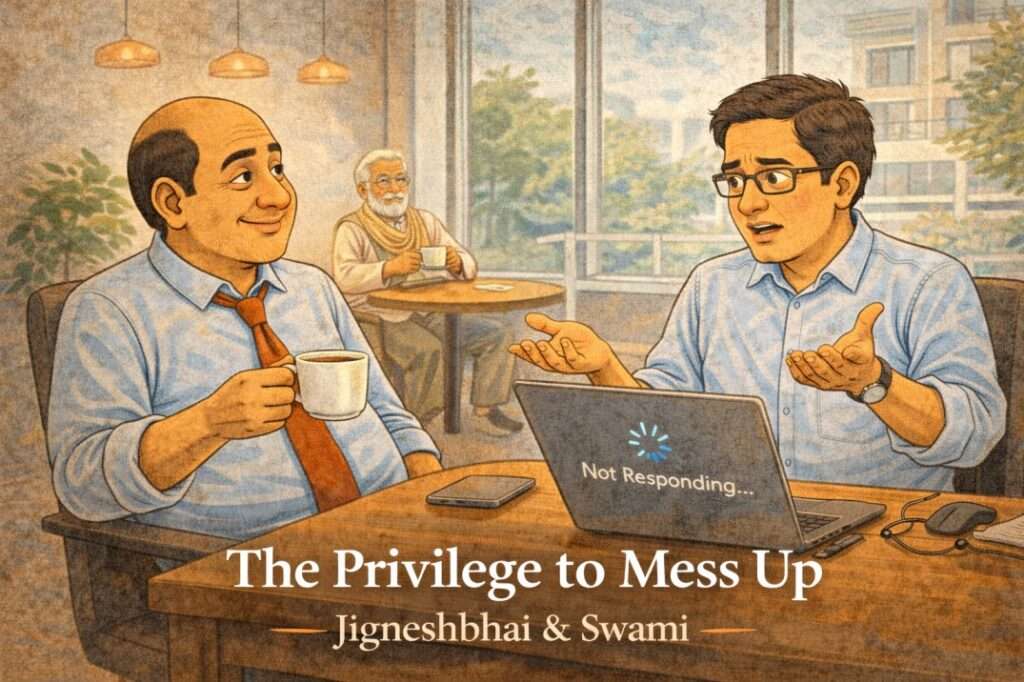
“I think I made a big mistake by buying this endowment policy twenty years back,” Swami said, peeping into a piece of paper, over coffee when we met at the café the other day.
“At that time, no one knew, least of all me, that term insurance is the only insurance we need. And this insurance salesman found me a sitting duck,” Swami continued. I realised that the paper he was carrying was the renewal notice of that same insurance policy.
Jigneshbhai noticed but did not say anything. Finding Swami a sitting duck was no surprise to him. After an awkward silence and a few sips of coffee, Swami said, “Thank God, it is maturing next year. I will get some lumpsum that I will use for a trip, I guess.”
I felt like sympathising with Swami. “Sometimes, we don’t know what we are thinking.”
“Yeah, but at least I did not buy those expensive ULIP insurance schemes!!” Swami smiled with a palpable sense of relief. “And I did buy term insurance and mutual funds later, based on the sane advice of ours truly..,” he added, pointing towards Jigneshbhai.
We looked at our wise friend to say something, but he was busy reading an article. Finally, after a few moments, he looked up.
“Corporate history is full of big blunders,” he said. “Errors of commission. Errors of omission. Errors of judgement.”
We were still stuck on Swami’s smaller blunders, but Jigneshbhai had moved to bigger ones. He probably guessed the thoughts in our mind.
“Everyone makes blunders. It is a matter of perspective,” Jigneshbhai continued. “Nokia neglecting Android, and BlackBerry not taking iPhone seriously were big blunders.”
Swami and I nodded, as Jigneshbhai referred to the article he was reading from.
“So was Microsoft buying Nokia’s Mobile business. But there is a difference in the blunders.”
Swami and I stopped sipping our coffee. And like always, Swami was the first to go.
“A difference in the blunders? There is a grading you have there, too?” he asked, with a snigger.
Jigneshbhai neglected that expression and carried on.
“Nokia could not afford to neglect Android, but at least they could manage to sell their mobile business,” he said. “Blackberry’s blunder of not taking iPhone seriously was something they could never recover from.”
“Like I might not have recovered if I would have put all my savings in an endowment policy or an expensive ULIP, or a fixed deposit, perhaps!!??”
Jigneshbhai was pleased to see Swami make his deductions, but he left it with a small remark, saying, “Kind of,” and continued on to his corporate blunders talk.
“Microsoft’s purchase of Nokia, while a blunder at that time, was something that Microsoft recovered from eventually,” Jigneshbhai said.
“This is definitely like my endowment policy blunder. I could recover from it,” Swami remarked, and Jigneshbhai nodded.
“The key is to be aware of what blunder you can recover from. Microsoft has the privilege of messing up. Blackberry didn’t enjoy it,” Jigneshbhai said, pointing towards his article.
He continued referring to it. “It says that if you can get yourself in a situation where you have the privilege of messing up, it is far more exciting, far more fulfilling and, eventually, whether it works or does not, far more useful to learn.”
Swami and I felt satisfied that what Jigneshbhai said resonated with us. But we didn’t say anything but simply smiled, musing over the many blunders in the past that we had committed, but, perhaps, didn’t pay much for it, simply because of having the privilege to mess up.
Our thoughts were broken when we saw the wealthy old man, who spoke cryptically, walk towards our table. He had been listening to our chat for a while, perhaps. He had much more experience than us and might have committed and recovered from more blunders than us.
“It is important to differentiate between blunders which you can’t recover from and experiments in which you have the privilege of messing up,” he said, standing next to me and Swami, and resonating what Jigneshbhai had said earlier.
But he left us with a wiser point to ponder when he added, “I have learnt to be careful of the first, and grateful for the second.”
***