


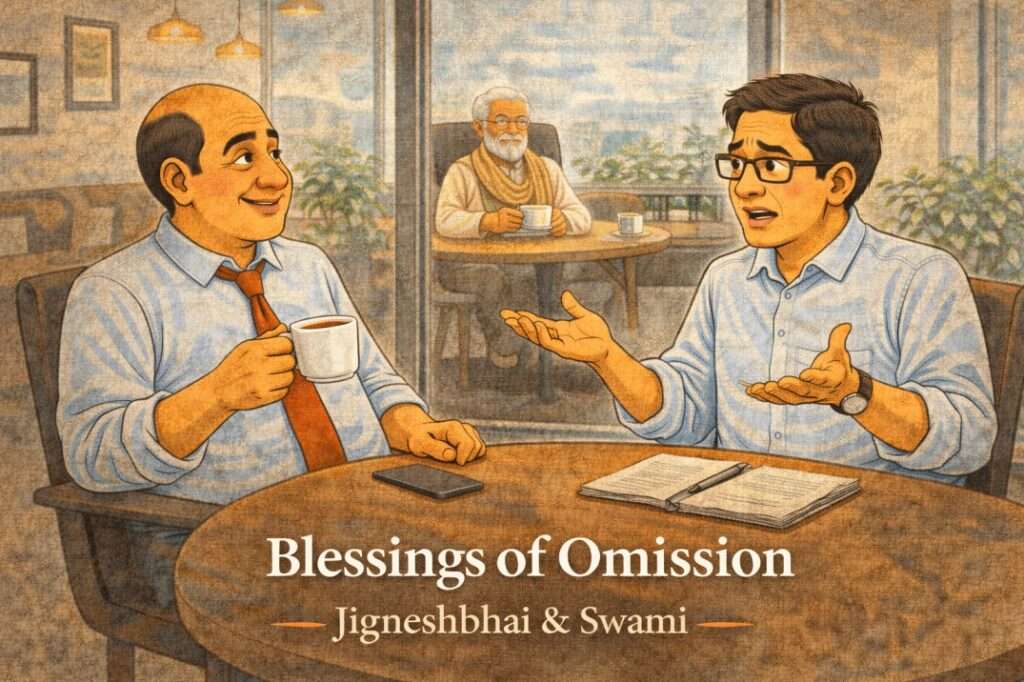
“An error of omission is a mistake that happens when something that ought to be done isn’t done,” Jigneshbhai read aloud from a book that he was carrying. It drew my and Swami’s attention from our coffee.
“But are they errors always? The things that you miss. The stuff that you omit?” he asked us.
Swami was enthusiastic as always to respond to our wise friends’ questions. For once, he was not the one asking them. He always sought opportunities to give answers.
“That may be relevant in some cases,” he said. “But I find myself most often doing the wrong things – something that ought not to be done in the first place.”
It brought a smile on Jigneshbhai’s lips. I tended to agree with Swami on this.
“Most of the stories of mine that have failed miserably have been stories that shouldn’t have been written at all,” I said.
“Was it because they were written badly?” Jigneshbhai asked out of curiosity as always.
“No.. Mind you, those were not stories that were written badly. In fact, editors evaluated them for writing craft and found them ok.”
“So, they were written well?” Jigneshbhai reaffirmed.
“Yes, they were. If you go purely by merit.”
“Then what happened?”
“They were written on topics or characters that didn’t interest my audience. You know dystopian fantasy or science fiction, and that kind of stuff,” I said. “And in some cases, it didn’t even interest me when I read them again. Yes, really.”
“Haha.. amazing. So, it is not error of omission!” he remarked.
“Absolutely, it should have been omission of an error, I should have skipped them altogether,” I said. Swami, so far, felt left out of this discussion. So, he started now.
“It is a bit like all those projects I end up doing at work that shouldn’t be done in the first place. Mind you, they get done efficiently and at the lowest price!” he said, leading to another loud guffaw from Jigneshbhai.
Swami wasn’t used to such positive responses from our wise friend. He went on.
“Or those meetings that Raichand sets that shouldn’t happen at all. But mind you, they are run well to the clock, someone takes minutes and circulates them. Then it leads to a plethora of actions that shouldn’t have happened at all,” he said.
We smiled and nodded in the knowledge of the kind of meetings Swami had in mind. He had told us about them often in the past.
“That is a lot of time, money and effort wasted in doing things efficiently that shouldn’t be done at all,” Jigneshbhai said. Both Swami and I remarked in unison, “Yes!!”
“Does that book you are carrying say anything useful about what to do with these?” Swami teased Jigneshbhai in earnest. He remained silent.
“Now I eliminate such ideas when they arise,” I replied. “Such elimination is the best form of efficiency, not wasting time on things that don’t matter and shouldn’t be done in the first place,” I said.
Of course, Swami wasn’t convinced. It was not easy for him to eliminate projects that shouldn’t be done at all. I had more control over what to do and what not to do. I realized that Swami may not enjoy that liberty in his job. “I wish someone told Raichand how to do that!” he mused.
That is when I saw the wealthy old man from the sprawling bungalow who had been listening to our chat all the while walk across to our table. “Omitting what ought not be done is the opposite of the errors of omission,” he remarked. “Let us call them the blessings of omission.”
***