


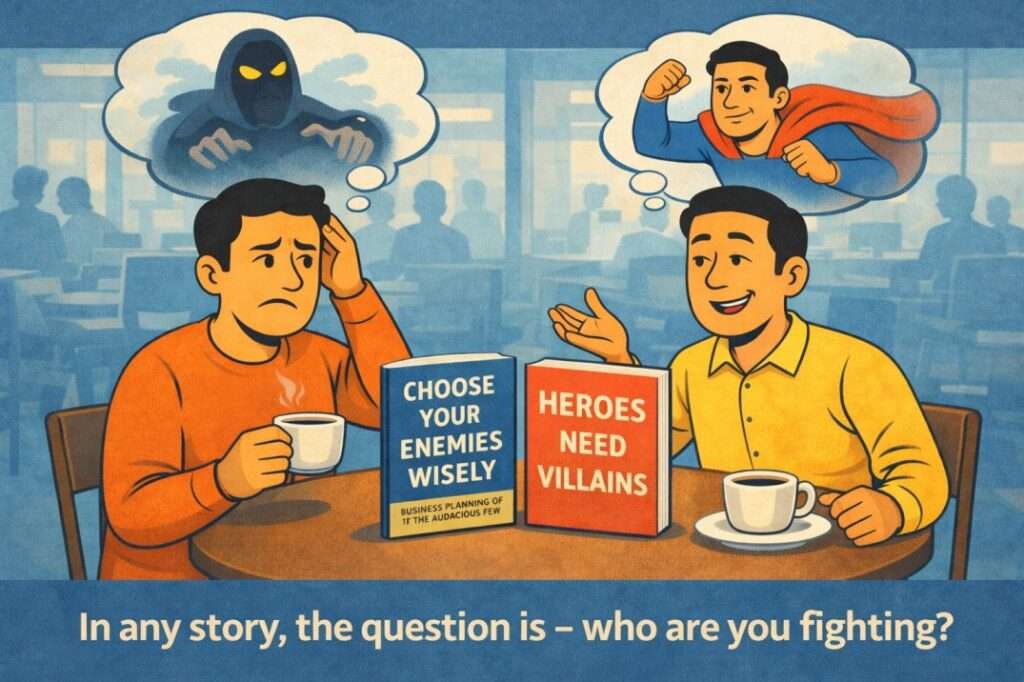
“Choose enemies that give you energy, not drain your energy,” Jigneshbhai said as we met for our coffee last weekend. He was reading from a book that he seemed to have picked up. It said ‘Choose Your Enemies Wisely: Business Planning for the Audacious Few’. Swami and I peered into the title with curiosity as he lifted the book to show it to us.
“It seems like picking an enemy fuels an army,” Jigneshbhai continued. “It turns out that it fuels any group of people.”
This had piqued Swami’s interest. “Army – yes. But any group of people?”
“Yes,” Jigneshbhai answered. “A company. A team playing a game. A religion. A nation. Any group of people – even those who may not have a real enemy. But picking one, real or imagined, fuels them, it seems.”
Swami and I didn’t say anything. But I felt intuitively that our wise friend was right. For a hero to shine, there has to be an villain. He was engrossed in his current pet topic.
“It may have to do with our evolution, but having an enemy seems to focus us – whether as a group or as an individual,” he said. “We can see it for ourselves in the examples around us.”
Swami was not yet ready to accept it blindly. He was looking for more. “Like?”
“Well you can go back in history. USA earlier picked USSR. It fueled them. Then China picked USA. It fueled a nation again. And if you were to look at examples from business, Avis picked Hertz. Pepsi picked Coke. And so on and so forth,” Jigneshbhai read from his notes. He seemed to have spent some time on this topic while reading his book.
Swami nodded his head. “Even I work better when I pick Raichand as my enemy rather than my boss,” he chuckled.
“Yeah, it works even for individuals,” Jigneshbhai grinned. “It provides focus – whether good or bad, real or made-up.”
“It works even in made-up stories,” I chimed in. “In every story, there has to be an enemy.”
Jigneshbhai smiled in agreement but Swami had a frown.
“Yes, someone who the main hero is fighting,” I continued. “It can be a something, or a some situation too. Or it could be an enemy within. But there has to be one,” I said with the conviction of experience.
“Without an enemy, there is no fight,” I reiterated. “Without a fight – or conflict – there is no story.”
Swami agreed with both of us now. The frown had gone away. It seemed like, between us friends, there was no enemy now.
It was then that I saw the wealthy old man from the sprawling bungalow walk towards our table. He must have been listening to our chat.
“So in any story, whether in the real world or in the imagined one, the question is – who are you fighting?” he asked. And as we finished our coffee, he left us smiling when he added, “Once you pick the enemy, the story follows.”
***