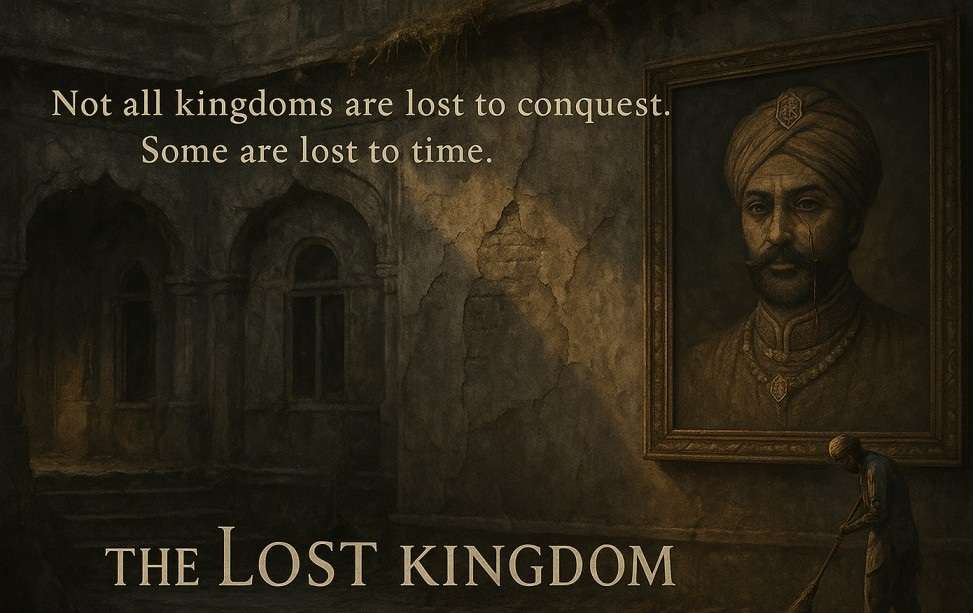
“Tribhuvansinhji Bapu, my husband’s great grandfather was no ordinary man. During his time, the Raja of Domli got a 9-gun salute from the British wherever he went. Domli was no insignificant state, we had our own Coat of Arms,” she told Nikhil when he called her that morning.
Despite his travels over the past so many years, Nikhil had no idea where Domli was. Neither did he know what a 9-gun salute and a Coat of Arms meant. He assumed it was something important. Despite his head being blank, he remarked in all earnestness, “Wow. That’s amazing.”
It would have been impolite to say anything else. Or to say nothing at all. After all, he was talking to the wife of the fourth generation descendent of the erstwhile King of Domli. He had heard that they still had a palace and a bunch of servants who called her Rani Saheba and her husband Bapu Saheb.
“In the late 19th century, Tribhuvansinhji returned to Domli after graduating from Cambridge. He developed an interest in cricket and construction,” she continued. “When he came back to Domli from UK, do you know what he did?” she asked. The question met continued blankness from Nikhil. “He ordered the reconstruction of the kingdom’s sewage systems. Domli was the first place in India to get a modern sewage system,” she said. “And did you know what he did next? He built a palace with magnificent cricket grounds? Did you know that Randeepsinhji, Dilipsinhji… and many cricketers of independent India owe their early years to those grounds in Domli?”
Nikhil, of course, knew none of these. He continued his exclamations, dotting the conversation. She didn’t wait for them though.
“It is our country’s misfortune that the annals of history have no mention of this great man and his kingdom,” she said. There was a tinge of emotion in her voice. Nikhil noted it but did not know how to react. He found himself in a strange cocktail of confusion, amusement, and potential discovery. How on earth was he to have any idea about Domli and its erstwhile rulers? To be honest, he hadn’t heard anything about them before that morning.
“People like you have to help us and join in our mission. We have to bringing Domli on to the tourist map,” the Rani Saheba said. That, Nikhil noted, was the real point of her discussion. “You must visit us during your trip. Don’t worry, we will make all arrangements for you at our palace,” she added.
The prospect of staying at a palace, even though of the erstwhile kingdom of Domli, was exciting. Nikhil immediately made plans and confirmed to her that we will definitely visit them. He called me and told me that our trip was going to have an interesting detour. It was a visit to Domli, hosted by an erstwhile queen and king in their palace.
***
It turned out that three days later we reached Domli. But it was not the palace but a dilapidated hotel that we landed up in. Nikhil and I wondered why. It might have come to the notice of the Rani Saheba that we looked nowhere like royal blood, we concluded. It was fine with us. In fact, for commoners like us, a hotel was more than enough. A visit to meet the royal family in their palace was still on the cards.
A crew of one old man – the cook-cum-caretaker-cum-housekeeper-cum-waiter – welcomed us. The rundown place looked like a hotel that even commoners might not have selected on their own. The old man with sparse, white hair played his roles to perfection. On every occasion, he made it a point to mention that we were “Rani Saheba’s” guests and were welcome at the hotel.
The hotel itself was a perfect example of what a hotel should not be.
The expansive wasted open land had unkempt, overgrown grass. No one had maintained it for months or more. There was no well-defined place to park our car. Hence, like the royal family that owned the place, we parked it wherever we felt like it. The vast space housed a small building that we, at first, thought contained the rooms. But that building only had the kitchen and the restaurant.
The crew of one asked us if we would like to have food. When we appeared tentative, he decided that he should take us to our rooms first. He asked us to walk along to the adjacent building.
That was another small building which contained a total of five rooms. The lobby was roomy for no reason in particular. Without looking at the rooms, the one-man crew who had now turned into the reception counter, asked us how many rooms we would like.
Nikhil suggested that we would like as many as the booking said. But the reception man had no idea. So he gave us three rooms – two for the two of us, and one, spare. We nodded and he opened the locks of the room doors. Both the doors creaked as if someone had touched them after a very long time. The one-man crew then turned into housekeeping. He got a broom, dusted the rooms, and let us in.
The rooms themselves were huge. Nikhil and I could have filled each of them with a family or two. One end of the room to the other was so far apart that it was enough for a small game of home cricket. It had a large wooden bed, a heavy wooden table, two chairs, two desks, and two wardrobes. It had an air conditioner that didn’t work and two fans that creaked. Even after all these, it still had space for me to have my morning exercise if needed, all inside the room.
The only things missing in the room were a jug of water, any semblance of room service and a working telephone. The bathroom had a leaky tap but no soaps or bath towels. It was clear that a king who had someone at his beck and call had built this hotel. No hotelier, let alone a businessman, worth his salt could have done this. Such a colossal waste of space was only possible for someone who had it in plenty. And someone who had little by way of knowledge of what a hotel should look like.
“The food is ready,” the one-man crew, who had now turned into room service, told us after ten minutes. We walked to the small building which housed the restaurant. The restaurant had old, antique furniture – long tables with eight or ten chairs, but no people. Nikhil and I pulled a chair and it creaked again like the doors of the rooms.
The food itself was warm, fresh, and tasty. We gobbled it up like gluttons who hadn’t eaten for days. The dishes and the spread made us believe that food was the best part of being guests of royalty.
The one-man crew who now turned waiter was gracious. He forced us with extra servings of ghee-topped rotis and oily dishes. The pretext was always that we were “Rani Saheba’s” guests.
Soon after lunch, he told us that someone will come to pick us up after an hour. That someone would show us around Domli and then take us to the palace. He told us that we could take rest till then.
Back in our rooms, Nikhil and I felt something uncanny in this whole experience. Big rooms, no people. A hotel with only one all-in-one attendant. One cook in the kitchen. No signs of any other cars in the compound. A deserted lobby. Dusty chairs. Creaking doors. Overgrown grass. Complete Silence.
By the time the afternoon got over, Nikhil and I were eager to meet Rani Saheba and Bapu Saheb.
***
But we had to wait longer.
At 5 pm, when we got out for a cup of tea, the one-man crew had now turned into travel concierge. He told us that the person who was to take us around had played truant.
“Young man. He must have found something else to do,” the old caretaker said. “It is not like the olden days, youngsters don’t follow orders anymore,” he added, and burst into a loud guffaw. A replacement was in place, and on his way, he assured us.
“Ambalika Devi is sending Khetobaji,” he said.
Nikhil and I looked at each other. Neither of us had heard either of the names before. We wondered who they were.
“Ambalika Devi is the sister of Bapu Saheb,” the one-man crew said. Nikhil and I smiled and nodded as if we knew their entire family tree. So, the king had a sister – another royal member, we noted. We waited for more details to emerge, especially for the other name, but nothing did.
Fifteen minutes later, we saw a fat, middle-aged man with a round, unshaven face and a rotund belly. He got off from his old scooter and limped towards us. He wore a grey bush shirt hanging loose over black stitched trousers that barely stayed on his waist. He pulled them up every few steps while limping.
When he got close, he gave us some sort of a casual bow and salute. It was a welcome greeting for guests of the Rani Saheba who were not quite royals themselves. We nodded in acknowledgement.
“Khetobaji,” he said. He looked like a lifelong servant of the royal family. We smiled at him. Nikhil pushed a hand forward, but Khetobaji didn’t shake it. He bowed down in reverence.
“Didi Saheba sent me,” he said.
“Oh, yes,” Nikhil said, though he had never seen her. To be sure, he didn’t know there was a Didi Saheba five minutes back. “Where will you take us?” he asked.
Khetobaji stole a confused glance at the one-man crew, and then remarked, “Old Palace. Umm.. then Royal Temple Grounds?” I wasn’t sure if he was asking us or telling us. Even he wasn’t sure if he was to ask or to tell. He wasn’t sure what we expected.
We were ok with anything. In any case, we didn’t know what to do in Domli. All that we knew was that the Rani Saheba had invited us, and, at some point today or tomorrow, we were to meet her.
“When will we meet Rani Saheba?” Nikhil asked, while I observed Khetobaji and the one-man crew.
“After that. In the evening,” Khetobaji said.
“Will you come in our car?” Nikhil asked. He shook his head and pointed to his scooter.
“Ok, we will follow you,” Nikhil said. We were ready to leave and walked to our car.
***
Back in the car, Nikhil and I exchanged furtive glances and raised eyebrows. Who was this Ambalika Devi and why had she sent us this Khetobaji? Why was he taking us to all these places? Both of us had the same questions, but no answers. Both of us shrugged our shoulders and went with the flow.
“Let us see what this guy shows us,” Nikhil said.
“Yeah, hope the king and queen are part of his plan,” I said. Nikhil nodded with the same hope and started driving behind Khetobaji and his shaky scooter.
As soon as we got out of the hotel premises, he took a turn into a village road, or a taluka road, at best. I googled Domli, and it said that it was a taluka with a population of around 150,000 as per the latest census. It also said that it was a former princely state (among the 400-odd states that annexed to India in 1948). But in present day and time, it seemed nothing like that.
Khetobaji entered a crooked lane which had small shanties and shops by its side. He drove slow to let us absorb the sights and sounds of the Domli kingdom. He stopped at a circle which had a large statue. Nikhil and I stopped behind him. It was a statue of a man with a big turban sitting on a horse, holding a sword in one hand. Khetobaji got his scooter next to the driver window of our car. He pointed at the statue and said, “Tribhuvansinhji Bapu.” With both his hands, he offered his prayers. We did the same inside the car.
After the statue, the road got better and straighter. About a hundred meters down that road, Nikhil and I saw a big gate to a large, old structure.
“Umm.. He is taking us there,” I said, pointing to it.
Khetobaji took his scooter to the gate and waited for us. We looked for a place to park. But he ordered an old security guard, who with a lot of hesitation, opened the gate and let our car inside.
The structure must have been around fifty feet tall, with a clock tower on top. It seemed unused and not visited for a long time. It had a large wooden door. From the outside, it looked like it had a roundabout staircase over two or three floors. While it might have been grand when in its full glory, it was evident that it must have been so only in the far flung past. I could see many places where the stones were full of pigeon waste. The walls had dried moss gathered over the years at many corners.
“Old Palace,” Khetobaji got off the scooter and told us.
We moved closer to him, but Khetobaji stiffened out of the blue. I saw that his eyes turned into a gaze fixed behind us. He bowed down from his waist in a salutation. We looked behind. A woman in her sixties in a well draped, embroidered sari and full sleeved blouse walked into the gate behind us.
“Didi Saheba,” Khetobaji whispered, as the woman walked from the gate towards the door where Nikhil and I stood. With folded hands and a smile on her face, she introduced herself.
“Rajkumari Ambalika Devi,” she said.
“Hello,” Nikhil said, and not knowing anything better, I said, “Hi, Didi Saheba.”
“Would you like to look inside our old palace? My great grandfather built it with a lot of care in 1891,” she said. Nikhil and I weren’t so sure about it. We were keen to go meet Rani Saheba.
“Sure, we would be very keen to look inside the old palace,” Nikhil said. He then added, “unless we are getting late for our appointment with Rani Saheba and Bapu Saheb.”
That remark seemed to have turned off the lively colour from Didi Saheb’s face. Her face turned pale. The smile went away, and a smirk replaced it. Almost a scowl of irritation and suppressed anger.
“Oh, they can wait,” she said, waving with her hand and dismissing any urgency. “Khetobaji, are you taking them to the new palace from here?” she asked with a tone of authority.
“Ji, Didi Saheba, if you allow me to,” he said with his head bowed down to the ground. Nikhil and I looked at their conduct and thought we were in some kind of bygone era.
“I assure you that this old palace is worth your time. You will find that a lot of your urban friends would find it interesting,” she said. “I will pass on a message to inform my brother and his wife that you will get to their palace after this,” she said.
“Sure, Madam,” Nikhil said, and I nodded. She then called someone on the phone, and asked Khetobaji to open the door to the old palace.
For the next hour or so, Nikhil and I were at the receiving end of the glories of the Domli kingdom. While our ears listened about the past, our legs walked in the lonely, dark corridors of the present. She took us through the life size pictures of her ancestors from the 1800s to the mid-20th century. A large hall which used to be the durbar was the only one which had lights. The entire old palace was otherwise mired in darkness. In many places in the high ceiling, it was full of cobwebs. When we reached the top near the clock tower, she showed us the view. She saw how her great grandfather oversaw Domli from his perch up there. Nikhil and I saw only a crumbling village in dire need of modern infrastructure.
We parted ways with her after taking some photographs. She wasn’t very keen that we go to the new palace. She insisted that this old palace was the real piece of history. But she realised that it was the main purpose of our visit and let us go.
Khetobaji sat on his scooter again. We told him that it was dark now and we should skip the temple grounds now. He was hesitant to start with and called someone. But both Nikhil and I insisted, after which he finally relented. I could see a sense of trepidation taking root on his face as he called someone on his phone again. He then agreed to now take us to the new palace.
***
The road to what turned out to be the new palace was muddy with pockets of grass on the sides. Khetobaji stopped at a place between two structures. On the left was an old, wooden building of three floors with a small door on the ground floor. On the right was a massive structure with two white pillars supporting it. From the car and in the dark, we couldn’t see how tall it was. It might have been thirty or forty feet. Between the two pillars were a series of marble steps, eight or ten in number leading up to an aisle. At the end of the aisle was a big wooden door with a glass pane in the middle.
“New Palace,” Khetobaji said, and asked us to come up the stairs.
A gatekeeper stood there with uniform and turban. I had seen them only outside five-star hotels in the city. But this was the real thing, though the palace was no five-star hotel. He frowned at us at first. But when Nikhil and I smiled at him, I saw a smile emerge from his bushy moustache.
When we walked through the door that he opened, it led us to a big living room. It had a twenty-foot ceiling and a big mural on the wall. Laid out in a semi-circle were a few large wooden sofas with plush cushions. Three men, presumably servants of the royalty, loitered around for no particular reason. We realised that they were there to welcome us. They pointed us to the sofas.
A woman in her late thirties, or at best, early forties, stood near a long table. It was in the far corner of the room, in front of an antique piano. She wore a modern looking designer dress with lipstick embellished by makeup on her face. Next to her, on the sofa, sat a man in his late fifties. He had a crop of white hair, a clean-shaven face, and a paunch that was hard to miss behind a stylish shirt.
With folded hands, the woman said, “Madhulika Devi. I am so glad to see you.” Then she pointed to the man on the sofa and said, “This is my husband.” The man got up and shook hands with us.
So these were the Rani Saheba and Bapu Saheb, after all, I surmised. The age difference between them surprised me, but I neglected it, for the moment.
“I hope you didn’t face any problems in finding Domli,” she said.
“No, not at all,” Nikhil said. “The people at the hotel and Khetobaji were very hospitable too,” he said. There was only one person at the hotel, I remembered, but I let it be.
“Wonderful,” Madhulika Devi said. “Did he take you to the old palace?” she asked, glaring at Khetobaji. He looked down to the floor and nodded, as if in apology. She then turned to us and said, “I hope my sister-in-law didn’t bore you with all the details on that old pal..…..”
Before Nikhil or I could say anything, Bapu Saheb cut her short. “Oh, it is a wonderful heritage palace. Replete with history,” he said. I noticed that Rani Saheba pursed her lips and looked into blank air.
“Oh, yes.. we went there. Thanks,” Nikhil remarked.
“But a lot of people find the new palace more interesting,” Madhulika continued.
“Yes, of course. It depends though.. Whether history or the present interests you more,” Bapu Saheb said.
An old servant entered with a tray of glasses that had fruit juice. While we partook it, Bapu Saheb explained how the mix of fruits in the juice comes from the mix of fruits in his orchard. He told us that his grandfather and father had developed a fruit orchard next to the temple grounds.
“It was more than a hundred years old,” he said. “But the onset of industry has reduced rains. The harvest from the orchards has gone down after independence. But more so, in the past two or three decades,” he added.
“I have never seen the great harvests. He keeps talking about them, though,” Madhulika interjected.
Another old servant came in a few minutes later with plates and snacks in trays and served us. Bapu Saheb explained the origins, ingredients, and heritage of every snack. The servant paused while he completed it before serving the next one. It seemed to be like a well-rehearsed routine.
For the next one and a half hours, over snacks and juice, we learnt new things about Domli. That the same great ancestor had built the new palace in the early 1900s. Since then, it had been the royal family’s primary house. The palace had 45 rooms, 11 of which were below the ground and out of use because of water accumulation. Out of the remaining 34, half of them were bedrooms, and about ten of them were guest rooms. The remaining consisted of play areas, kitchens, and servant rooms. Most of the rooms, except 5 or 6, were not in use.
Rani Saheba spoke about the potential to convert some parts of the palace into a hotel. “We should talk about it. Domli has great potential as a weekend getaway,” she said.
“More than one weekend. It is close to so many places. During my childhood, I remember going to….,” Bapu Saheb said.
“We are looking for partners like you to convert this palace,” Rani Saheba interjected.
“Yes, we have at least ten rooms,” Bapu Saheb remarked and looked at his wife. There was an uneasy silence after the partnership proposal. Nikhil and I focused on the snacks and let it pass.
“Actually, after independence….,” Bapu Saheb started and Madhulika looked elsewhere. “We were the biggest losers. The British and the Indian politicians left us nowhere, and our people celebrated.”
Madhulika interjected and asked me and Nikhil if we would like another serving of the sweets. Both of us shook our heads with a smile, while trying to listen to her husband.
“My great grandfather was the first……,” he continued unabated. We heard the entire stories of his ancestors again. It was an almost virtual repeat of what his sister, Didi Saheba, had told us about an hour ago at the old palace.
Madhulika continued serving us with snacks. She asked us about ourselves and, in general, was hospitable in her parallel world. Her world was more contemporary than her husband. For him, 19th century Domli was the beginning, middle and end of the world.
At around 9 pm, we decided that we should go back to our hotel. Khetobaji got on to his scooter again and we followed him. He was talking to someone on the phone. Half way through, Nikhil asked him to stop while we picked up some bottles of water for the night.
“How many years have you been in Domli?” I asked Khetobaji while we stood near the shop.
“Since my birth. My father worked for Bapu’s father, and my grandfather for his father,” he said.
Nikhil and I raised our eyebrows in surprise. We thought such things happen only in movies. We remained silent and went back to our car. Some things seemed still shrouded in mystery.
“Did you notice how she countered everything he said?” I asked Nikhil, who nodded in agreement.
“Well, it could very well be husband-wife tiffs…,” he reasoned.
“But even in royal couples?” I asked.
“Hmm, who knows?,” he sighed. “In any case, why bother? It is a matter of a night before we get out of Domli,” he added.
I nodded in agreement, and we focused on Khetobaji and his scooter, lest we lose our way in the dark. We followed Khetobaji and went to the hotel to retire for the night. We looked forward to leaving in the morning.
***
When we reached the hotel, the one-man crew went up to Khetobaji. He pointed a finger to the restaurant. Khetobaji went in and had a look.
“Dinner is ready,” the one-man crew said.
Nikhil and I were already full. We didn’t expect dinner after all the snacks we had stuffed ourselves with. But the old man had made it and insisted that we have it. We freshened up and walked inside the restaurant. Khetobaji was also sitting there.
Next to him was a young man in his twenties. He wore a checked t-shirt and blue jeans, and a pair of sneakers. He carried a bag and was fiddling with his phone. Nikhil and I were happy to see someone who looked like a commoner. We thought at least there was another visitor, but we were wrong in our assessment.
He smiled on seeing us. It looked like he was waiting for us. Khetobaji got up on seeing us and introduced the man to us. “Yuvraj Saheb,” he said.
The man shook hands with me and Nikhil.
“I saw that you were at the new palace with my father,” he said. “But I thought that it might be better to come and meet you here.”
“Oh, you were there as well?” Nikhil asked.
“Well.. umm.. not exactly there.. I stay in the building opposite the palace. We don’t have many visitors, you know. It’s not that hard to figure out if someone has come in,” the young man said.
“Oh, yes, indeed. We just returned after a great meeting with your parents,” Nikhil said, and I nodded with cheer.
The smile on his face waned, out of the blue. It seemed like we had touched a wrong chord.
“She is not my mother,” he slammed back, and looked at Khetobaji. The servant walked forward towards me and Nikhil. He bent close to our ears and whispered, “Yuvraj Saheb is the son of Padmavati Rani Saheba.”
“Oh, sorry.. I mean.. I didn’t know that… Yuvraj Saheb,” Nikhil stuttered.
“That’s fine.. You can call me Jaideep.. Or just Jai,” the young man said. “Let’s have dinner.”
It was getting a bit tough to keep track of so many royal family members cropping up. But Nikhil and I tried our best to recollect and place them, while also having dinner on a full stomach.
It turned out that the decrepit building in front of the new palace was where he lived. Bapu Saheb had given it to Yuvraj Saheb aka Jai, who lived there with his mother, Bapu’s first wife. Bapu had also promised him the temple grounds, though he didn’t seem to be happy with it.
He wanted to build an arts and crafts village for tourists at the grounds. He said he will go all guns blazing on the project “after things get sorted out soon.” We didn’t understand what that meant but did not bother to ask. He showed us a few samples of the work that he had got along in his bag and asked us to visit it before we leave.
“Khetobaji was going to get you there today evening, but I guess you got late,” he said, reminding us.
“Never mind, I am sure you will find lots of interesting stuff for your urban friends out there. Don’t forget to send them there when they visit Domli,” he insisted. Nikhil and I nodded.
“Khetobaji will get you there, tomorrow morning,” he said as he stood up to leave after dinner. He pointed to the man who seemed to be the common go-to servant for all members of the royal family of Domli. Khetobaji nodded without complaint.
After Yuvraj Saheb left, our stomachs were so full that we found it hard to walk back to our rooms.
“We are meeting new royal members wherever we go,” Nikhil said, once inside.
“Yeah.. everyone seems to have some stories to tell.. something to sell.. about Domli,” I remarked.
“I always used to wonder how kings and queens looked, what they did all day… how they lived.. now we know. fun, isn’t it?” he said.
“Yeah – that’s true,” I said. “I am not sure it’s fun for them, though.. and their people.”
“Anyway, let’s sleep now. I want to leave before Khetobaji turns up again in the morning,” Nikhil said.
I nodded with a loud and hearty laugh, which reverberated in the empty hotel. Then I walked to my room.
***
Late that night, my stomach rumbled, forcing me to wake up and stay awake for a long time. It was well past midnight. The curtainless windows made me feel as if someone was peeping into my large room. I didn’t know what to do. I felt it might be better to walk along the lobby.
When I went there, I heard some voices. I realised it was the one-man crew and Khetobaji who were talking aloud in the building next to the rooms. I tried to eavesdrop when I felt a tap on my shoulder from behind. I shuddered in shock wondering who it might be in the darkness.
But when I turned, I heaved a sigh of relief. It was Nikhil. He had stepped out of his room on seeing me, as he had been unable to sleep too due to the voices.
We tiptoed across the lobby and the voices started getting clearer. It was pitch dark. The only other sound was that of the night insects. We walked on the grass careful that we didn’t step on anything. We stayed out of sight but went close enough to the building to hear what they were saying.
“Eh.. Khetobaji.. Will Bapu close this… place.. this hotel?” the one-man crew stammered.
“Who can say? This last year or two has been.. a disaster.. Bapu is.. broke.. Bhai.,” Khetobaji replied.
“I know – that’s why I asked. He hasn’t paid me.. or the cook.. for six months…,” the one-man crew said. “No one comes here.. Who comes to Domli? And those who come… are Rani Saheba’s guests..”
There were sounds of glasses clinking and bottles clanging between their voices.
“SSssshhhhh… talk softly.. even at the palace…it is.. same situation,” Khetobaji said. “Plus Bapu has to fight this Didi Saheba’s case.. She wants a share; she has claimed the old palace.. you know that?”
“Yeah.. I know.. Rani Saheba and Didi Saheba should settle it out of court.. …”
“But it won’t happen.. They are .. you know that.. not talking.. Didi Saheba didn’t like the second marriage…”
“But they should not fight in the family…”
There was some more rattling of glasses.
“Yeah.. Bapu worries for Yuvraj… Rani Saheba will not let him take anything..,” Khetobaji said.
“.. from the new palace? or hotel..?
“Both… even from the school..“
“Oh.. Poor Jaideep Bapu… He is stuck.. with empty grounds.. after the second marriage..”
There was silence for a few moments, followed by a pouring of something into a glass.
“He has also filed a claim.. in court,” Khetobaji said.
“In court? Bapu will make sure he gives Yuvraj something..,” the one-man crew remarked.
“If he can.. if anything remains. I don’t know how much will be left… Bapu’s name doesn’t work anymore.. He lost the elections also..”
“Hmm.. true. new generation voters…Khetobaji.. tell me.. be honest.. Will Bapu… then.. close the hotel?”
“Who can say? Who can tell… he is our.. master,” Khetobaji said, and the two old voices drowned.
Nikhil and I looked at each other without saying a word. We turned around and tiptoed back to our rooms. The voices of the servants echoed into our ears in the depth of the silent night.
But then so did the voices of the royals. Prisoners of their birth. Unable to let the past go, unable to embrace the present as it was, unable to take a leap of faith to chart the future.
In the wee hours of the morning, Nikhil and I packed our bags, got ready and stepped out without telling anyone. We pooled in cash to cover our hotel stay, and then, added some more. We left it in an envelope near the one-man crew and Khetobaji, who were sleeping on the lobby floor. Tribhuvansinhji Bapu shed a tear from his portrait on the lobby wall as we stepped out of his lost kingdom.
***