


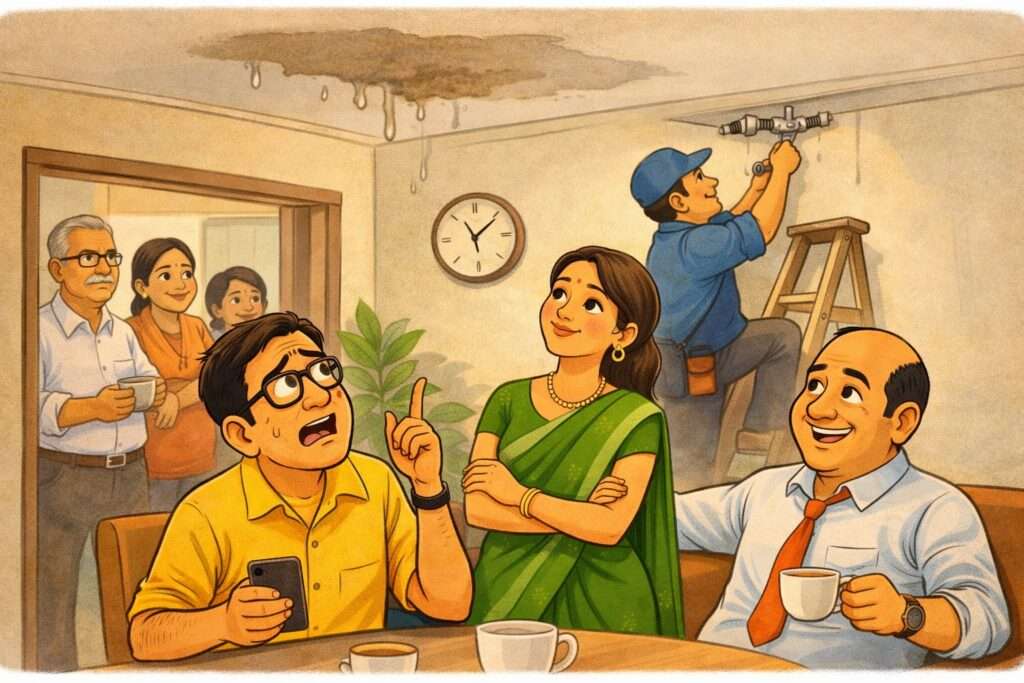
When I walked into Swami’s apartment one Saturday morning, I found him standing in the middle of his bedroom, pointing at the ceiling.
“Look at that!” he said, as though unveiling a crime scene.
I squinted. A patch of dampness spread like an inkblot above his wardrobe. The paint was peeling at the edges.
“Seepage,” I said.
“Seepage?” Swami repeated, as if the word itself was offensive. “This is just the beginning. It starts with seepage. Neglect it and the internal structure will crumble. The building is already 17 years old. Vidya doesn’t understand the gravity.”
Vidya, who had appeared at the doorway with her coffee, raised an eyebrow. “Gravity? It’s just a damp patch. Call a plumber and fix it.”
Swami glared at her. “Plumber! It’s not that simple. It is at the edge of the common, external wall. These are structural issues. Society must take responsibility. I can’t let this pass.”
Swami looked at me with wide eyes. “Do you realise this could be the start of our society’s problems? What if other flats with external walls are also facing it? We must check.”
“I can’t take this lightly. No one should. Someone will say ‘residents ignored early warnings’.”
Vidya sighed and went back to the living room. I followed her out before Swami’s paranoia exploded further.
By evening, Swami had made noise on the building WhatsApp group and mobilised support.
Swami: “URGENT. Water seepage in my flat. External walls. Needs immediate society action.”
Secretary Iyer: “There have been complaints in some flats. We’ll discuss it in committee.”
Sharmaji: “Earlier, walls lasted 50 years without complaint. Quality is suspect nowadays.”
Mrs. Verma: “My balcony also has stains. Please include.”
Random resident 1: “Last monsoons, even I faced this problem.”
Random resident 2: “Anyone renting their car parking slot? DM.”
And so, by the next afternoon, the Seepage Subcommittee was born.
The meeting was held in the society hall. A long table was set up, as if they were negotiating a peace treaty. Secretary Iyer presided, adjusting his spectacles.
Sharmaji sat with a notebook, nodding gravely. Mrs. Verma brought Rocky, her Labrador, who sprawled on the cool floor tiles.
Swami didn’t ask whether pet dogs were allowed in committee meetings. He sat a safe distance away from Rocky. But he was the protagonist arguing the issue today. He carried printouts of photographs of his ceiling and waved them like evidence in court.
“Look at these! Damp patches spreading bit by bit, like early stage cancer. Today it’s my flat, tomorrow it could be yours.” He stabbed the papers with his finger for emphasis.
“My balcony already has a wet stain,” Mrs Verma added. Swami and the others neglected her.
I sat at the back with Jigneshbhai, who looked as amused and calm as ever. Vidya had stayed home, wisely avoiding the drama.
Iyer cleared his throat. “The first thing we need to do is to identify the source. Is it the leak from the flat above, or from the terrace water tank pipes? Or heavy rains overnight?”
Everyone looked at Swami.
“Definitely the tank,” Swami declared. “I’ve done the research.”
Sharmaji shook his head. “Not necessarily. Could be bathroom pipes also. Aren’t they just outside the exterior wall? Newer buildings have such defective designs.”
Mrs. Verma raised her hand. “My balcony stains should also be recorded. It’s the same water.”
Rocky barked, perhaps in support.
Swami slammed his palm on the table. “This is not about individual balconies or individual walls! This is about the ceilings over our heads getting weaker.”
The debate spiralled. Someone said it is the flat owner’s problem to fix. Another argued that this is a structural problem that the committee should take up. Another said it is a problem due to rains that have been heavy this year. “Wait for a month and the patches will go away!”
“And till then, should I risk a collapse?” Swami argued. The arguments and counter arguments continued. Iyer wanted to form a technical team. Sharmaji insisted on historical context. Mrs. Verma suggested a special fund. Swami demanded immediate action.
“One person at a time, please!” Iyer shouted, though no one listened.
Two hours passed. The subcommittee discussed everything except the actual seepage. Budgets, builder’s responsibility, flat owner’s problem, legal recourse, even the society’s future vision statement — all came up.
At one point, Sharmaji suggested inviting the original builder for a panel discussion. Swami nearly fainted.
From the back, Jigneshbhai whispered to me, “They’ve managed to turn a bucket of water into an ocean.”
I nodded, trying not to laugh.
Meanwhile, back in Swami’s flat, Vidya had quietly called the plumber she knew. She had called him on one occasion earlier, to fix the leakage under the kitchen sink.
By the time the subcommittee adjourned, the plumber had already inspected the wall and ceiling corner, identified the problem, replaced a pipe joint in the bathroom above, and scraped off the peeling paint.
The stain was gone. He assured Vidya the damp patch would dry in a couple of days.
Swami returned home in the evening, flushed with self-importance.
“That committee is hopeless,” he declared, collapsing on the sofa. “Two hours of talking, no conclusion. I presented all the evidence, but nobody has the courage to act. Bureaucracy has destroyed this country.”
Vidya handed him a cup of coffee. “Oh, really?”
“Yes,” Swami said passionately. “We are surrounded by incompetence. I fought like a lion. But one man cannot do everything.”
At that moment, Meera wandered out of her room, earphones still plugged in. She looked up at the ceiling casually. “Oh, the stain’s gone?”
Swami blinked. “What stain?”
She pointed at the bedroom. Swami rushed in, dragging me along. The damp patch above the wardrobe was gone, the paint scraped clean, a neat patch of plaster applied.
Swami stared at it, speechless. “But… how?”
Vidya walked in behind us. “The plumber came in the afternoon. Fixed it. Thirty minutes.”
Swami turned slowly, as though betrayed. “Plumber? Thirty minutes? While I was battling the committee?”
“Yes,” Vidya said calmly, sipping her coffee.
Jigneshbhai broke into a grin. “Some battles are better fought without a subcommittee,” he said.
Swami opened his mouth, then closed it. His shoulders slumped. “All that effort… wasted.”
The lights went off at that time. It was a power cut. When the backup restored them, Swami muttered, “Next time, I’ll form a subcommittee for lights.”
Jigneshbhai raised an eyebrow. “Sometimes, it is better to keep the subcommittee in the dark.”
We all broke into laughter. Swami joined with a sheepish smile. He was staring at the ceiling, perhaps wondering whether the seepage had truly gone or was it his eyesight failing.
***
Check out The Ultimate Jigneshbhai & Swami 5 eBook Boxset Collection HERE.